
 sales:
 sales:






 Cloud & on-premises CRM
 Point of Sale (POS)
 Taskwave Field Service ERP

Why doesn't an AI-built website bring leads?
AI website builders optimize for output that looks finished. Leads come from pages that match search intent and give a local buyer a reason to call. Those are two different jobs.
Vibe coding means describing what you want in plain language and shipping whatever the AI hands back. It's fast and impressive. It also skips the boring part. The boring part is where leads live. A generated page doesn't know which services your customers actually search for. It doesn't know your strongest reviews or the neighborhood you want to rank in. So it fills the gaps with fluent, generic copy that sounds like every other site in your niche.

What happens after the first rebuild?
You keep prompting. Fix this headline. Add a section. Change the CTA. Each prompt solves today's request and forgets yesterday's decisions. That drift is measurable. Your marketing pages drift the same way. Nobody notices until rankings slip.
Rebuild with AI or optimize what you have?
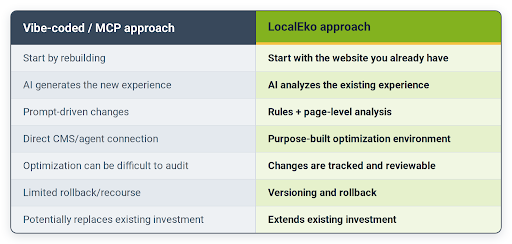
There are two ways to use AI on a business website. You can let it generate a new experience, or you can let it analyze the one you already have. Here's how they compare
1. Why start with the website you already have?
Your current site has history. It has pages Google already trusts and URLs other sites link to. It also has data on what visitors do. A rebuild resets that. New URLs and new copy. You trade proven signals for a prettier homepage and hope rankings come back.
2. Should AI generate pages or analyze them?
For lead generation, analysis wins. Generated content is plausible by design. Analysis asks a harder question: what is this specific page missing for this specific buyer? That might be a FAQ that answers a real objection. Or a service area your customers search for and your page never mentions. The generation won't find those gaps. It writes around them.
3. Why do prompts make inconsistent changes?
Every prompt is a fresh guess. Ask twice, get two different answers. Across 40 location pages, that becomes 40 slightly different brands. Rules work differently. You define once what every page needs: a clear CTA and local schema markup, for example. Then page-level analysis checks each page against those rules. The result is predictable. Your brand stays yours.
4. Is it safe to connect an AI agent directly to your CMS?
It's convenient. It also has a probabilistic tool to write access to your live business. The risk is documented. Veracode tested over 100 language models and found that 45% of AI-generated code samples failed security tests (Cloud Security Alliance). A purpose-built optimization environment keeps the AI inside guardrails. It suggests and prepares changes. You decide what goes live.
5. How do you know which AI change brought the lead?
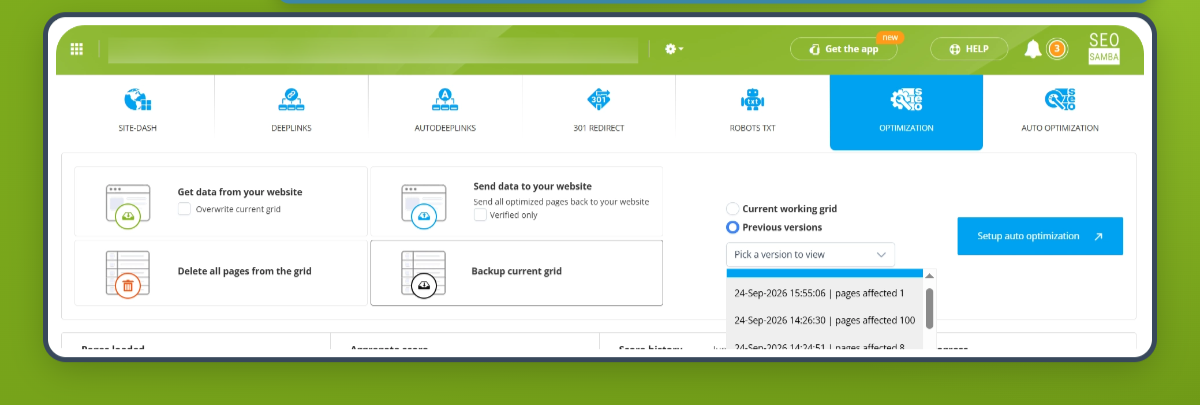
With prompt-driven edits, you usually don't. Changes pile up with no log, so you can't connect a new lead to the edit that earned it. You also can't spot the edit that quietly killed your best-converting page. Tracked, reviewable changes fix that. Every edit has a before and an after, with a date attached. Now you can actually learn what works.
6. What if an AI change hurts your rankings?
You roll it back. If you can. Most vibe-coded workflows have limited recourse. The previous version lives in a chat history somewhere, or nowhere. Versioning turns a scary mistake into a two-click fix.
7. Does AI optimization replace your existing website investment?
It shouldn't. You or your clients paid for design and development, plus years of SEO work. A rebuild writes that off. Optimization keeps the foundation and makes it earn more. For agencies, that also means a client conversation about growth instead of a conversation about starting over.
How to handle step two on your own website
Step two starts with an audit of what you already have, before any AI writes a word. Here's the order I'd follow.
Pull your lead data first. Which pages bring calls and form fills today? Those pages get protected, never rebuilt on a whim.
Write your rules down. What must every page include? A CTA above the fold and your service area are good starting points. These rules become the checklist AI works against.
Run page-level analysis. Look for gaps on each page: missing FAQs and thin service descriptions are the usual suspects.
Review before publishing. Treat every AI suggestion as a draft. Approve it or send it back.
Keep a change log. Date every edit so you can tie results to specific changes.
Make rollback non-negotiable. If a tool can't restore the previous version, it doesn't get publish access.
Simple as that. Boring? A little. But this is the part that turns traffic into leads and gets you AI results.
Download case study on how to get your business into AI results
How LocalEko handles step two for you
LocalEko is an autonomous marketing and sales automation engine by SeoSamba that optimizes the website you already have. Its new Optimization Grid is built on the right column of the table above.
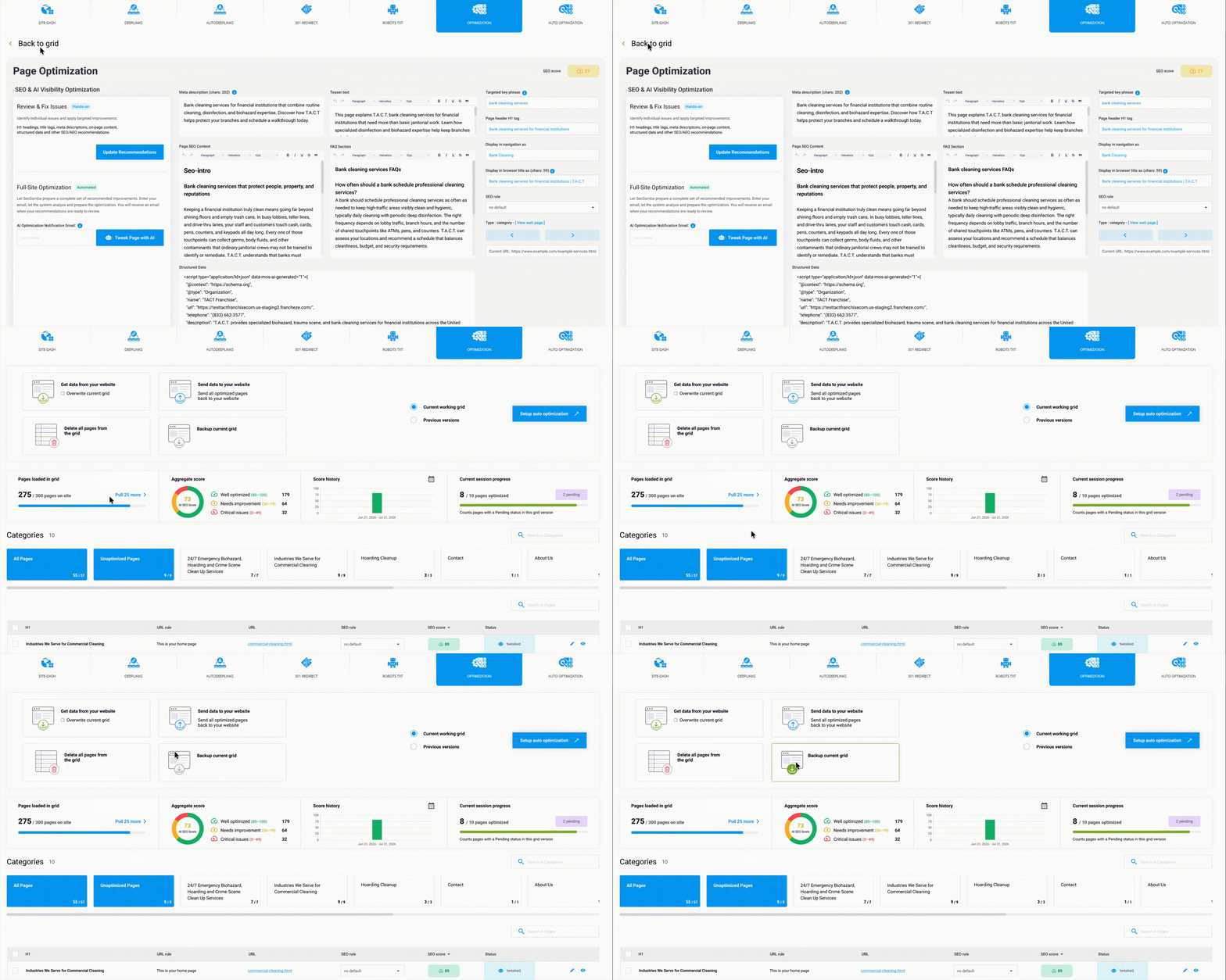
Here's what that means in practice:
It starts with your current site. LocalEko analyzes each page individually and prepares relevant FAQs and AI-optimized copy for it. Everything is ready to insert without breaking your layout or branding.
It works from rules. Page-level analysis runs against defined optimization rules, so 1 page or 100 location pages get the same standard.
It runs in its own environment. Changes are prepared in a purpose-built optimization workspace. Your CMS never gets an AI agent with free rein.
Every change is tracked. You can review it before it goes live and see later what changed and when.
Every change can be undone. Versioning and rollback are built in.
It's ready for AI search. LocalEko adds schema markup and optimizes content for answer engines like ChatGPT, Gemini and Perplexity.
LocalEko builds on SeoSamba's marketing infrastructure, developed since 2008 for multi-location organizations, franchises and marketing agencies. Agencies can also run it fully white-label under their own brand.
Ready for step two?
You don't need another rebuild. You need the site you already paid for to start bringing leads.