
 sales:
  sales:





 Cloud & on-premises CRM
 Point of Sale (POS)
 Taskwave Field Service ERP
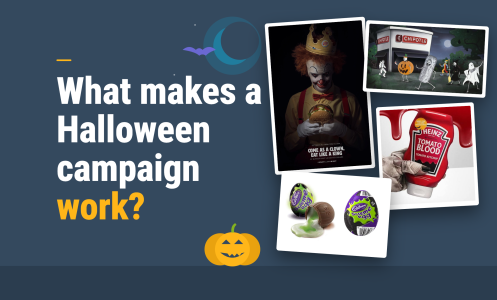
We asked marketing experts and founders one question: what is your favorite Halloween marketing campaign, and why does it work? Six out of ten named the same campaign: Burger King's 2017 "Scary Clown Night." The other picks were Reese's seasonal plays, Home Depot's twelve-foot skeleton "Skelly," Crest's candy taste test and Fanta's Haunted Universe. Below, the experts explain their choices in their own words. After that, we look at the patterns that run through their answers.
The clear favorite: Burger King's "Scary Clown Night"
In 2017, Burger King offered a free Whopper to people who came to its restaurants dressed as clowns on Halloween. It was a jab at McDonald's and its mascot, timed to the creepy-clown panic of that year.
Réland Logan, Founder and Brand Strategist, Gray Digital Marketing
"Burger King's Scary Clown Night is my favorite, the one where anyone who showed up dressed as a clown got a free Whopper. Nobody had to explain the joke about who the clown was, and that is the test a brand position has to pass. Most Halloween marketing borrows the season's imagery and says nothing about the brand, and this one said the only thing Burger King has ever wanted to say. I am sure that one kept Ronald up at night."
Mihai Cirstea, CEO, Site Pixel Media
"My favorite Halloween campaign is still Burger King's "Scary Clown Night" from 2017. Anyone who showed up dressed as a clown got a free Whopper, a pretty obvious dig at McDonald's that got picked up everywhere. It worked because the timing was perfect (right during that weird clown scare panic), the offer was simple, and it basically turned customers into walking billboards just by getting them to dress up and post about it.
The campaign didn't cost much. BK gave away some burgers and got millions of dollars worth of press coverage in return. We've seen the same thing happen with clients: if you latch onto something people are already talking about and take a clear stance, they'll spread it for you. The lesson is to pick a side, make it entertaining, and give people something to do instead of just asking them to watch."
Daniel Preston, Founder, LiveInCare USA
"One of my favorite Halloween marketing campaigns is Burger King's "Scary Clown Night." It was effective because Burger King took something already embedded in popular culture, the creepy-clown association, and turned it into a playful competitive jab at McDonald's, while giving customers a concrete reason to visit its restaurants on Halloween.
From a marketing perspective, the strongest part was that the idea was simple enough to understand instantly, distinctive enough to generate conversation, and connected the creative concept directly to an in-store action."
Maciej Turek, Independent Growth Consultant
"My favorite is Burger King's 2017 "Scary Clown Night." It used a simple retail mechanic, inviting people dressed as clowns to claim a Whopper, and turned it into a playful competitive jab that fit Burger King's challenger voice. The campaign connected a timely cultural cue, a clear in-store action and an idea people could explain in one sentence. The lesson is that seasonal marketing works best when participation carries the story, instead of simply dressing a standard promotion in Halloween visuals."
Bram Vermolen, Founder, Space'M Online
"Burger King's Scary Clown Night is one of my favorite Halloween campaigns because it gives the audiences the reason to participate. Here's what I know: People are encouraged to wear clown costumes and visit Burger King restaurants, where they can get a free Whopper. What makes it memorable is that whoever participated became a part of the campaign itself. They did not only show their creativity through the visuals, they also took time to make it unforgettable by doing the challenge.
I also find this very interesting because the audience are given the clear reason to take action, so instead of just reading the ad, they were influenced to join and show their support. From what I know, this campaign helped generate 2.1 billion earned impressions and coverage in more than a thousand articles across countries. For me, that combination of participation, visibility, and a clear next step is what made the idea work."
Sinead Taylor, Marketing and Content Lead, Blaze Media
"This campaign was the perfect mix of poking fun at their main competitor (McDonald's), while getting some UGC with minimal effort from Burger King. The slogan for this was absolutely fantastic too - 'come as a clown, eat like a king'. The offer was simple: the first 500 guests who came to selected restaurants as a clown on Halloween got a free Whopper. It happened 8 years ago, and people are STILL talking about it."
Other expert favorites
David Finberg, CEO, Peaks Digital Marketing: Reese's seasonal plays
"My favorite is still Reese's "You got chocolate in my peanut butter" style seasonal plays, when brands treat Halloween as a product story, not a costume slap-on. The ones that work marry a clear offer to cultural timing and make the creative shareable without needing a 12-slide brief. Memorable Halloween campaigns earn attention because they're specific and human, not because they shout "spooky" louder."

Tabitha Naylor, Founder: Home Depot's "Skelly"
"My favorite is Home Depot's twelve-foot skeleton, "Skelly." Nobody planned for that thing to become a cultural moment. It was a home decor item that people fell in love with in their own front yards, filmed, and posted everywhere, and Home Depot let that happen instead of trying to control it. That's what made it work, it didn't feel like advertising, it felt like something people wanted to show off, and the company backed it with more sizes and styles instead of chasing whatever came next."
Saul Marquez, CEO and Founder, Outcomes Rocket: Crest's candy taste test
"Crest's Halloween campaign, where kids taste 'healthy' candy substitutes and react in horror, is the rare case of a health brand doing the holiday right. Oral care sells fear of sugar every October, and Crest flipped it by making the kids' disgust the joke, earning laughs in a category built on lectures. Health brands should take note. You win Halloween by joining the fun, not policing it."
Teresa Tran, Chief Operating Officer, LaGrande Marketing: Fanta's Haunted Universe
"My favorite is Fanta's Haunted Universe holiday campaign because this one feels like brand territory. I find it really interesting because each horror character appears in cans, in the packaging, digital content, and retail executions. The fact that this campaign did not just show a halloween imagery for attention, instead, it builds characters, stories, products, and experiences around the occasion which I think is really memorable for the audience. This seasonal campaign is one way for the brand to be remembered not only during the holiday, because this becomes their brand identity, actually, Coca-Cola described it as a platform intended to entertain fans for years. The creativity, the main idea, and the execution are an A+ for me!"
Tendencies in the experts' answers
Across ten answers, the experts praised the same few qualities again and again. Seasonal imagery alone impressed no one; what they valued was how the season served the brand.
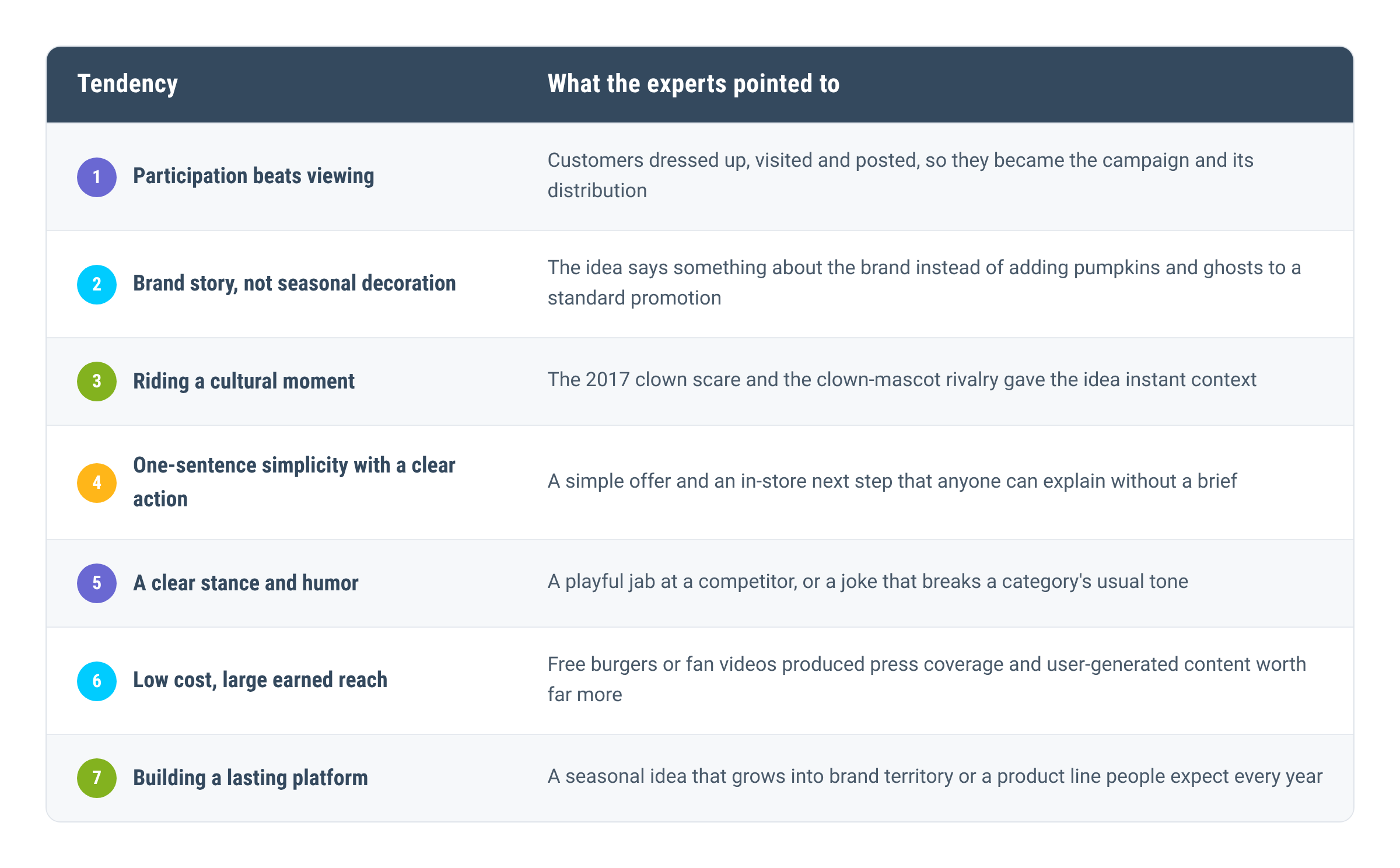
The Burger King dominance is itself a signal: almost a decade later, experts still cite a campaign whose mechanic fits in one sentence.
The best Halloween campaigns, according to these experts, use the holiday to say something only their brand can say. Burger King's "Scary Clown Night" won six of ten votes because it combined a cultural moment, a competitive stance, a one-line offer and a reason for people to show up and share.
For marketers planning their own seasonal campaign, the experts' answers suggest a simple checklist:
- Tie the idea to your brand's position, not just to Halloween imagery.
- Give people something to do: dress up, visit, post or show off.
- Keep the mechanic simple enough to explain in one sentence.
- Connect to something people already talk about, and take a clear, playful stance.
- If fans adopt an idea, back it and let it grow into a platform for future seasons.
About SeoSamba
SeoSamba is a marketing and CRM platform that unifies websites, SEO, CRM, POS, automation, and multi-location marketing into a single connected system.
Its infrastructure enables businesses, franchise networks, and marketing agencies to scale marketing execution while progressively adopting AI-driven automation through solutions like LocalEko.
LocalEko represents a shift from marketing as manual work to marketing as a continuous, background process – where visibility, content, and optimization happen automatically as part of a unified system.
Thank you for reading! We are looking for agencies to contribute and share their expertise in articles aimed at SMB's and Franchises. Please drop us a message with subject "ARTICLE" at lana@seosamba.com