
 sales:
  sales:





 Cloud & on-premises CRM
 Point of Sale (POS)
 Taskwave Field Service ERP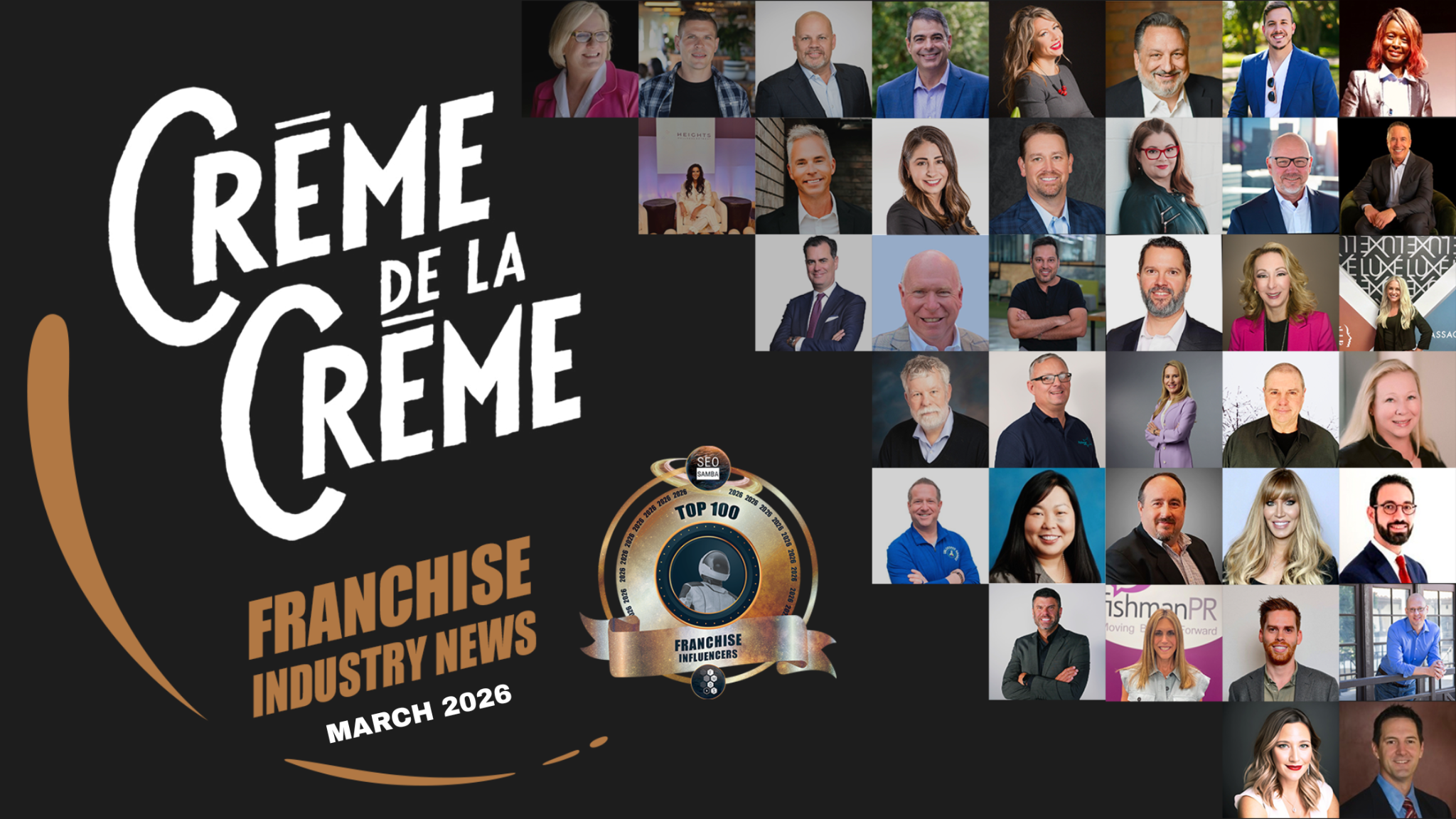
Welcome to Creme de la Creme: Franchise Industry News - a publication that brings you the latest news from the franchise world’s most influential characters.
In the March edition, you’ll find out what’s changing in franchise development strategies in 2026, why you should be sending out a monthly newsletter, the latest news about the American Franchise Act, and a scalable Youtube playbook for franchisors, plus we’re highlighting 10 winners each month from the 2026 Top 100 Franchise Influencers.
Sit back and relax as SeoSamba brings you highlights from the incredible world of franchise influencers, shedding light on the latest developments and achievements within the franchise industry.
The Results Are In! SeoSamba’s Top 100 Franchise Influencers of 2026
We’re proud to unveil the winners of the 2026 SeoSamba Top 100 Global Franchise Influencers list, honoring some of the brightest minds moving the franchise industry forward.
The first 10 winners include Adoniran Ferreira of STORsquare Portable Storage, Dani Peleva, founder of Franchise Fame, Kevin Lacey of San Churro, Tim Parmeter from Franchoach, Todd Bourgeois at NTV360, Matt Lovasz founder of T.A.C.T.- Trauma and Casualty Team, Jason West McReynolds, Fran Metrics, Michael Hyam of Franchise Assembly, Michael Webster, Franchise Chat & Franchise Connect, and Ford Saeks, Franchise Training Solutions.
Together, these leaders represent the innovation, education, strategic thinking, and community-building that continue to shape the future of franchising in meaningful ways. We will unveil 10 more next month, so keep an eye out for our next edition in your inbox in April!

SHAKERS & MOVERS
Franchise World Updates: Who's Moving Up and Who's Taking New Roles
Congratulations to all the professionals making strides in their careers! Here's a quick look at the latest movements in the franchise industry:

Justin Livingston- birdcall
New Role: VP of Franchise Development
Company Overview: Birdcall is a modern fast casual restaurant brand redefining the chicken category through quality ingredients, thoughtful menu design, and a technology forward guest experience.
David Tennyson- xceler8or
New Role: VP of Operations and Growth
Company Overview: xceler8or is a franchise development and growth acceleration group built by seasoned operators, franchise owners, and expansion specialists with decades of experience.
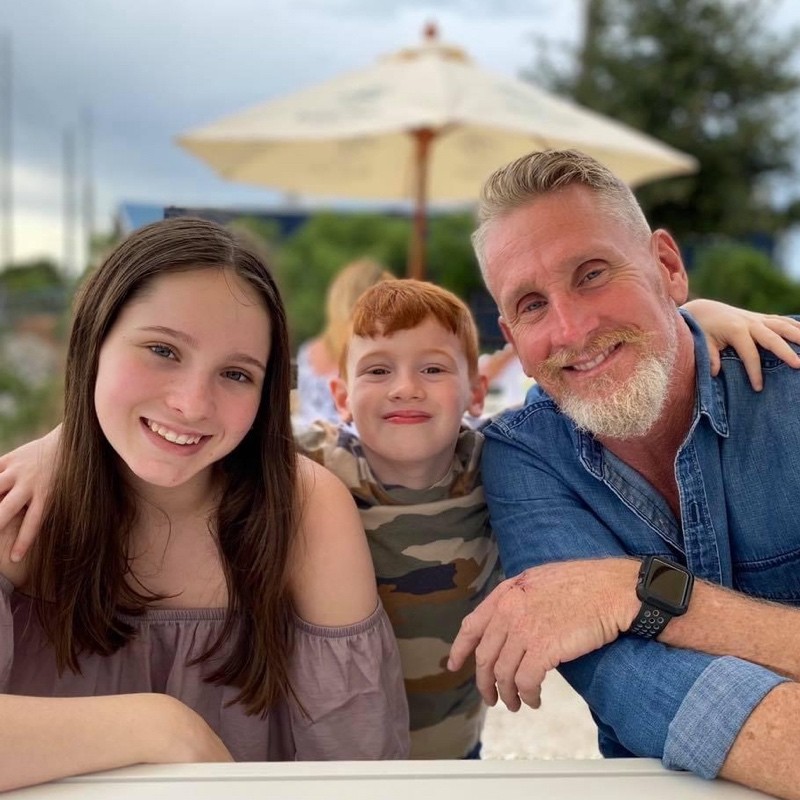

Spencer Perkins- BNI
New Role: Director of Marketing
Company Overview: BNI- Business Network International, is the world's largest and most successful referral networking organization, where hundreds of thousands of Members have unlocked exponential business growth.
Carla van Wyk- Resolute Education
New Role: COO of Franchising
Company Overview: Resolute Education is an Edtech company that provides comprehensive robotics and coding programs to schools and learners.


FRANCHISE DEVELOPMENT
What’s Changing in Franchise Development Strategies in 2026
Franchise development in 2026 is getting less “spray-and-pray lead gen” and more precision growth. The brands winning unit growth aren’t necessarily spending the most—they’re building cleaner systems: better data, tighter messaging, smarter automation, and a more direct relationship with candidates.
Here are the shifts showing up across the market right now.
AI integration and automation is moving from “nice idea” to daily ops
AI isn’t replacing franchise development teams—it’s quietly turning them into higher-output teams. You’re seeing AI used for content variations, lead nurture, follow-up sequencing, qualification support, and faster candidate response—because speed-to-lead still matters. Recent industry reporting shows AI adoption is now widespread in franchise development lead gen workflows, with a large share of teams already using AI tools in at least one area and more planning to expand usage in 2026.
What this means for franchisors: build AI into the process around your humans—automation for consistency, people for judgment and trust.
Data-driven marketing is replacing “platform preferences”
Development marketing is becoming more scientific: sharper attribution, clearer channel performance, and messaging that’s tested (not guessed). Industry trend reports specifically call out AI, automation, and measurement as core themes reshaping franchise marketing in 2026.
What this means for franchisors: your dev funnel should operate like a lab—track what converts by source, by message, by persona, then double down.
Direct-to-candidate websites are becoming the center of gravity
More brands are rethinking over-reliance on third-party broker networks and lead marketplaces—especially when lead quality, cost, and transparency don’t pencil out. The “broker slowdown” conversation is real, and it’s pushing franchisors back toward owned channels where they control story, qualification, and candidate experience end-to-end.
What this means for franchisors: treat your franchise development site like a conversion asset, not a brochure—clear value prop, proof, FAQs, financial clarity, and next-step CTAs.
Alternative financing is becoming a competitive advantage
Affordability and access to capital remain friction points, so brands are getting smarter about presenting financing pathways—SBA, ROBS, seller financing (for resales), equipment financing, and other options that reduce “deal stall.” You’re also seeing more education-oriented content around these funding routes to help candidates feel capable sooner.
What this means for franchisors: you don’t need to “sell financing,” but you do need a clear financing education lane (and vetted partners) so qualified candidates don’t disappear in the funding fog.
Purpose-driven branding is evolving from slogans to proof
Candidates—and customers—are more skeptical of glossy brand promises. Purpose still matters, but the expectation has shifted toward evidence: what you do, who you help, and what outcomes exist because your brand exists. That’s showing up in broader branding and loyalty discussions across 2025–2026.
What this means for franchisors: purpose works best when it’s operational. Show receipts: community impact, customer outcomes, franchisee success stories, and standards that back up the brand.
The practical takeaway
In 2026, franchise development is becoming less about “finding more leads” and more about building a system that earns the right leads—with better targeting, faster follow-up, stronger trust signals, and a clearer path to ownership.

FRANCHISE BRAND MARKETING
7 Reasons Why You Should Be Sending Monthly Newsletters
A customer newsletter is one of the cleanest brand-marketing plays a franchise system can make because it’s a rare channel you actually own. No algorithm mood swings. No pay-to-play toll booths. Just a direct line to people who already know your name.
Here’s why monthly newsletters are worth the effort—especially for franchise brands:
- You stay top-of-mind without always “selling.”
Most franchise services aren’t daily-consideration purchases. Customers don’t think about restoration, flooring, payroll, auto services, or junk removal until they need it. A monthly newsletter keeps you present in a helpful, low-pressure way—so when that moment arrives, you’re the brand they remember.
2. You build trust at scale.
Trust isn’t a slogan—it’s repetition. Newsletters let you consistently demonstrate expertise (“here’s what to do when…”), transparency (“here’s what the process looks like”), and proof (“here’s what customers are saying”). Over time, familiarity becomes a competitive advantage.
3. You amplify your reputation (quietly, but powerfully).
A newsletter is a perfect place to showcase reviews for specific locations, highlight before/after results, share local community involvement, and introduce real team members. That humanizes your brand and makes franchise locations feel less like “a place” and more like “people I can rely on.”
4. You drive more repeat and referral business.
A consistent newsletter gives you a natural reason to remind customers about additional services, promote seasonal offers, and ask for referrals without it feeling awkward. One well-timed reminder can turn into real revenue—especially when paired with a simple CTA like “save our number” or “schedule your annual check.”
5. You strengthen local brand lift inside a national system.
Corporate can provide the structure and core content while locations add local flavor—events, partnerships, staff spotlights, and market-specific tips. That creates the “big brand + local care” experience customers love.
6. You fuel your entire content engine.
Even though newsletters aren’t a “search channel,” they improve search and social performance indirectly because your best newsletter content can be repurposed into blog posts, social posts, Shorts/Reels, FAQs, and Google Business Profile updates. One monthly email can feed multiple channels.
7. You build compounding marketing equity you actually own.
Your list grows over time. Open rates reflect loyalty. Click data shows what customers care about. And unlike rented audiences, that equity doesn’t vanish when ad costs spike or platforms change the rules.
Done right, a monthly newsletter isn’t “another marketing task.” It’s a brand relationship engine—one that keeps your name familiar, your expertise visible, and your locations first in line when customers are ready to act.

FRANCHISE ADVOCACY & LEGAL NEWS
Bipartisan Congressional Support for the American Franchise Act
ICLG reports that the House Problem Solvers Caucus has endorsed the American Franchise Act( ^1), a bill introduced in September 2025 by Reps. Kevin Hern (OK) and Don Davis (NC), which the article says had 74 sponsors at the time of publication (ICLG published the piece February 3, 2026).
The article frames the bill’s goal as protecting the franchise model by narrowing when a franchisor can be treated as a “joint employer” of a franchisee’s workers under U.S. labor law—while still recognizing that franchisors set brand/quality/operational standards and franchisees remain independent operators. The concern, as presented, is that broad or inconsistent joint-employer standards can create unintended liability exposure for franchisors.
The “core” policy change described is a uniform, franchise-specific joint-employment test written into both the National Labor Relations Act and the Fair Labor Standards Act. Under that test, a franchisor would be a joint employer only if it actually exercises “substantial, direct, and immediate control” over essential terms and conditions of employment (examples listed include wages/benefits/hours and hiring/firing/discipline/supervision/work direction). Importantly, the bill (as summarized by ICLG) excludes routine franchise elements—brand standards, training materials, operating hours, minimum staffing levels, and general guidance—and emphasizes the control must be regular and consequential, not sporadic or minimal.
Finally, ICLG notes the proposal has attracted strong support from major industry groups, quoting endorsements from the International Franchise Association and the National Restaurant Association, both highlighting the desire to reduce “regulatory whiplash” and create a clearer, consistent standard.
Source: ICLG.com, “Bipartisan Congressional Support for the American Franchise Act,” February 3, 2026, accessed March 2, 2026. Disclaimer: The content above summarizes third-party reporting for general information and discussion. It does not constitute legal advice, and it does not necessarily reflect the views or positions of SeoSamba. For guidance on legal or regulatory matters, consult qualified counsel.

MEDIA & LEARNING
Youtube 201- Stop Posting Random Videos: A Scalable YouTube Playbook for Franchisors
Here’s the uncomfortable truth franchisors need to hear: most franchise YouTube channels aren’t “bad at video.” They’re bad at systems.
They post random clips when someone has time, chase “SEO tricks,” and then wonder why nothing ranks, nothing converts, and nothing scales across locations. Meanwhile, YouTube is sitting there like a giant, free intent-capture machine, happily rewarding brands that do three things consistently: answer one specific question, prove trust fast, and guide the viewer to the next step.
So here’s a franchise-friendly way to build a YouTube engine that franchisees can actually execute without chaos.
1) Stop making random videos. Build repeatable series.
If you want consistency across 20, 200, or 2,000 locations, you need formats—not inspiration. A smart content system is basically a set of “video templates” your network can reuse forever.
Five series that work especially well for service-based franchises:
- Search Magnet: Cost, timeline, what to expect. (These queries convert because they’re tied to real intent.)
- Objection Crusher: “Do I need a pro?” “What happens if I wait?” “Why is it expensive?” (These kill indecision.)
- Trust Builder: Walkthroughs, certifications, safety protocols, before/after, testimonials. (Trust is the product.)
- Local Authority: Seasonal issues and market-specific problems. (This is how corporate strategy becomes local relevance.)
- Partnership: Realtors, property managers, insurers, community services—whoever overlaps your customer’s moment of need. (Referral gravity is real.)
This is how a franchisor creates a channel that doesn’t depend on one charismatic owner or one marketing manager with caffeine and a ring light.
2) Retention isn’t magic. It’s structure.
YouTube doesn’t rank “the best video.” It ranks the video that gets clicked and then keeps people watching. That means your scripts need a spine.
A simple framework that works across almost any franchise service:
- 30 seconds to earn attention (call out the problem and stakes)
- 60 seconds to prove competence (show the process, criteria, proof)
- 90 seconds to convert (clear next step, what happens when they call, what to do next)
Then add pattern interrupts every 20–30 seconds: a quick visual change, on-screen keywords, a fast example, a cutaway to a job photo, a checklist overlay. This isn’t “TikTok brain.” It’s clarity. People stay when they feel guided.
Also: hooks don’t need to be cringe. The highest-performing openers are usually:
- “Here’s what people get wrong about ___”
- “If you’re dealing with ___, do this first”
- “Most DIY advice fails because…”
No jingles. No “Hey guys!” No logo montage like it’s 2009.
3) YouTube “SEO” is not tag witchcraft
YouTube SEO is mostly one thing: match a specific search intent, deliver fast, prove trust, guide to the next step.
The keyword strategy can be clean and franchise-ready if you bucket by intent:
- Emergency intent (NOW)
- Research intent (planning)
- Comparison intent (choosing)
Franchise rule worth tattooing (metaphorically): one video targets one primary query. If you try to rank for 12 things, you rank for none.
To support that query, your description should do two jobs: help YouTube understand the topic and help the viewer take action. The winning pattern is simple:
- What you do + who you help + where
- Clear CTA (call / request help / find a location)
- Short keyword-aligned summary
- FAQ bullets (each one phrased like a real search query)
- Trust block (certifications, social proof, testimonials)
- Links
And yes—chapters are sneaky AEO. When your chapter titles are written as questions, you’re basically handing YouTube a map of the answers inside your video.
4) Shorts should feed long-form, not become random chaos
Shorts are discovery. Long videos (and playlists) do the heavy lifting for trust and conversion. If your Shorts aren’t pushing viewers somewhere specific, you’re just renting attention.
Three Short types that consistently work for service franchises:
- Myth-buster: “No, bleach doesn’t solve this…”
- Mistake to avoid: “One thing that makes this problem come back…”
- Micro ‘what to expect’: “Here’s what happens when we arrive…”
The first 1–2 seconds matter brutally. Start with the problem and the action, not a greeting.
A simple linking system keeps it sane:
- Every Short points to one long video or playlist
- Mention it verbally (“Full process is in our longer video…”)
- Put it in the description
- Pin it in the comments
Repurposing becomes easy: 1 long video = 4–6 Shorts pulled from hook, biggest “aha,” top question, biggest mistake, and a proof/trust segment.
5) Conversion isn’t “salesy.” It’s guided.
Think of the channel like a museum tour:
- Each video is an exhibit
- Each exhibit points to the next
- The exit has one clear direction
For franchises, playlists are the conversion machine because they organize the journey by service and intent. Build one “funnel playlist” per major service:
- What it is / do I need a pro?
- Process / what to expect
- Cost & insurance
- FAQs / mistakes / safety
- When to call / next steps
Then keep your CTAs aligned to intent:
- Emergency: “Call now, 24/7 response, here’s what happens next.”
- Research: “Watch the checklist/process video next.”
- Comparison: “Here’s what to ask any provider; here’s what certified means.”
And measure the simplest thing that matters:
- Views → clicks to site from YouTube
- Calls that mention YouTube (train CSRs to ask “How did you find us?”)
- Form fills after watching (where attribution is possible)
You don’t need perfect tracking to validate impact—you need consistent signals.
The franchisor takeaway
The win isn’t “becoming great at video.” The win is building a repeatable, intent-driven system that corporate can support and franchisees can actually execute.
When you do that, YouTube stops being a content chore and starts acting like what it really is: a 24/7 salesperson that never sleeps, never misses a call, and never forgets the script.
__________________________________________________
SeoSamba’s Franchise Marketing OS now supports YouTube
From the SeoSamba Social app on your phone or desktop, you can now:
- Upload and post videos, shorts, and customer testimonials simultaneously to YouTube, Facebook, Instagram, LinkedIn, and Google Business Profile.
- Embed marketing directly into franchisees’ and field workers’ operations with our approval system.
- Display video reviews instantly in your website widget.
All in one place—simple, powerful, and designed to scale your marketing effortlessly.
Creme de la Creme is brought to you by SeoSamba, a marketing and sales automation software suite provider, with turnkey franchise development and franchise brand marketing solutions for emerging franchise brands. Each year, SeoSamba reviews thousands of nominees and awards the Top 100 Global Influencers in Franchising award to the most influential characters in the franchise world.
If you have news that you’d like to have published in an upcoming edition, you may submit it to influencers@seosamba.com for consideration.
Thanks for reading!