
 sales:
  sales:





 Cloud & on-premises CRM
 Point of Sale (POS)
 Taskwave Field Service ERP
Most advertisers judge their Google Ads performance by what they can see in the interface: conversions are coming in, click-through rates look acceptable, and the system reports steady optimization. On paper, everything appears to be working. Yet many businesses still feel a disconnect between reported success and actual results.
Revenue doesn’t quite match expectations, scaling spend feels risky, and decisions are made with a degree of uncertainty that never fully goes away. The issue is not always that campaigns are failing; it’s that a portion of the budget is operating without full visibility, and that gap accumulates over time.
The root of this problem sits in how performance is measured. Platforms optimize based on the signals they can capture, but those signals are inherently limited to their own environment.
Conversions may be counted more than once across channels, or attributed to the last interaction rather than the one that actually influenced the outcome. At the same time, broader targeting and automation can increase volume while diluting intent, which makes results look stable while efficiency declines. Reporting then becomes an exercise in assembling fragments of information from different sources, each telling a slightly different story. By the time inconsistencies are identified, the spend behind them has already occurred.
This is why even small inefficiencies have a meaningful financial impact. A business spending £5,000 per month on ads does not need a dramatic failure to lose money; a 15–25% gap between perceived and actual performance is enough to create a significant annual shortfall. What makes this difficult to detect is that nothing appears obviously broken.
Campaigns continue to generate activity, dashboards continue to update, and incremental improvements mask the underlying issue: the system is optimizing within a partial view of reality.
The question, then, is not whether Google Ads is delivering results, but how much of that delivery is truly aligned with business outcomes. Without a unified way to track performance across channels, reconcile attribution, and control spend at the account level, advertisers are effectively making decisions based on incomplete data. This is where the shift needs to happen.
Estimate Your Google Ads Waste
20%
Improving performance is not only about refining campaigns or adjusting bids; it is about establishing control over how performance is measured in the first place.
Platforms like SeoSamba address this gap by providing a layer that sits above individual channels, bringing attribution, reporting, and spend management into a single system. Instead of relying on isolated platform metrics, businesses gain a consolidated view of what is actually driving results and where the budget is underperforming.
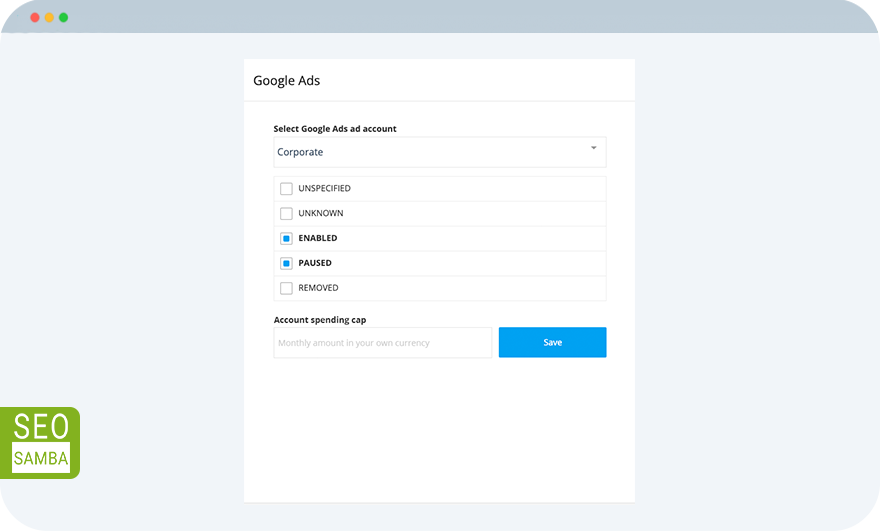
Google Ads Automated Account Budget Cap
If you’re managing multiple campaigns and clients in Google Ads, you’ve likely faced a major frustration: Google still doesn’t allow you to set an overall account spend cap. Their budget feature has remained in beta for over six years, with only about 10% of accounts randomly granted access.
With automated bidding algorithms becoming mandatory as manual CPC phases out, staying on top of overall spending and budget allocation is more difficult than ever. Juggling data to prevent overspending or missed opportunities is a constant challenge.
That’s where Automated Account Budget Cap comes in to save the day. With total budget control, simply set firm spending caps at the account level and the system will ensure you never exceed your limits.
That clarity changes how decisions are made. It reduces reliance on assumptions, highlights inefficiencies earlier, and allows spend to be directed with greater confidence.
Estimating wasted budget is not about assigning blame to campaigns or platforms; it is about recognizing that performance without full visibility is inherently imprecise. Once that becomes clear, the focus shifts from chasing incremental gains to addressing structural gaps. And in many cases, the most impactful improvement does not come from doing more, but from finally seeing what is already happening with enough clarity to act on it.