

 sales:
  sales:





 Cloud & on-premises CRM
 Point of Sale (POS)
 Taskwave Field Service ERP
At a glance, campaigns in Google Ads can appear to be performing well. Conversions are being recorded, cost-per-acquisition seems acceptable, and return on ad spend suggests positive momentum. For many advertisers, these indicators are enough to justify continued or increased investment.
Yet when those same results are compared against actual revenue, margins, or cash flow, the picture is often less convincing. The gap between reported performance and business outcomes is where the real issue begins.
This disconnect is largely driven by how profitability is inferred rather than directly measured. Google Ads reports conversions based on the signals it can capture within its own ecosystem, but those signals rarely reflect the full customer journey. A conversion may be counted at the point of interaction without accounting for prior channels that contributed to the outcome, or it may represent an action that does not translate into meaningful revenue.
As a result, campaigns can appear efficient while still attracting lower-quality leads, repeat customers who would have converted anyway, or interactions that carry limited commercial value.
Estimate Your Google Ads Waste
20%
The situation becomes more complex when multiple channels are involved. Paid search, organic traffic, direct visits, and remarketing efforts often intersect, each claiming influence over the same conversion. Without a unified attribution model, this overlap leads to inflated performance figures across platforms. What looks like consistent success in each channel may, in reality, be the same results counted several times. This creates a false sense of profitability, encouraging continued spend without a clear understanding of incremental impact.
Automation adds another layer to the problem. Smart bidding and machine learning features are designed to optimize campaigns based on available data, but they can only work with the inputs they receive.
If those inputs are incomplete or biased toward easily measurable outcomes, the system will optimize in that direction, reinforcing the same patterns. Over time, this can increase spend on segments that generate activity but not necessarily profitable growth. Because performance metrics continue to look stable or even improve, the underlying inefficiency remains difficult to detect.
What makes this particularly challenging is that nothing appears obviously broken. Campaigns continue to generate conversions, reports continue to show positive trends, and incremental adjustments give the impression of progress.
Meanwhile, the business experiences inconsistent returns, difficulty scaling, or pressure on margins that cannot be fully explained by the data at hand. The issue is not a lack of performance signals, but a lack of alignment between those signals and actual business outcomes.
Addressing this requires a shift in how performance is evaluated. Profitability cannot be determined solely within a single platform’s reporting environment; it needs to be measured across the full marketing ecosystem, with attribution that reflects real contribution rather than isolated interactions.
This is where platforms like SeoSamba play a role by providing a consolidated view of performance across channels, aligning conversion data with revenue, and introducing controls that operate at the account level rather than within individual campaigns.
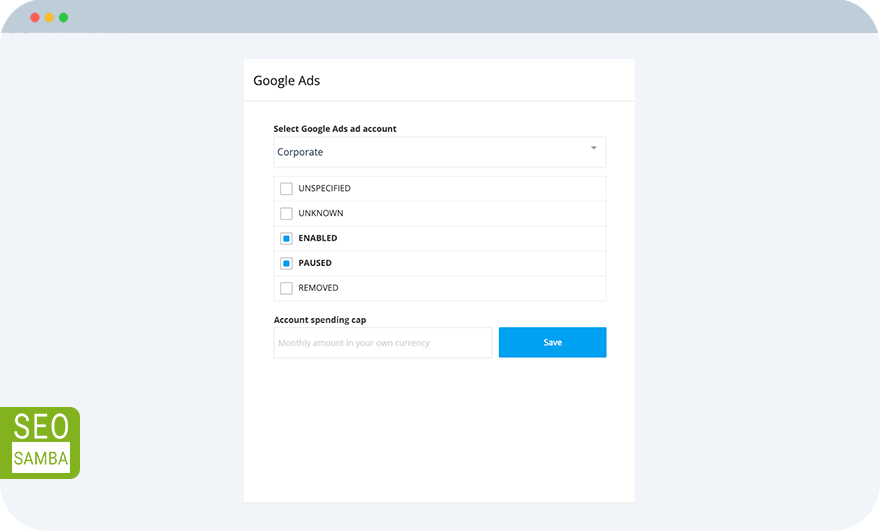
With that level of visibility, the question changes from “Are these campaigns generating conversions?” to “Are these campaigns generating profitable growth?” The distinction is critical. Conversions can be increased through optimization, but profitability depends on understanding which conversions matter, how they are influenced, and whether the associated spend is justified. Without that clarity, it is entirely possible for campaigns to look successful while contributing less to the business than expected.
In practice, the difference between perceived and actual profitability often comes down to what is being measured and how decisions are made from that data. When performance is viewed through a fragmented lens, efficiency is assumed rather than verified. When it is viewed holistically, inefficiencies become visible and actionable.
For many advertisers, that realization is the turning point: not that their campaigns were failing, but that they were operating with a partial view of reality that made profitability difficult to assess with confidence.
FAQ